Patmos
3.6/5Where John wrote the Apocalypse — a UNESCO monastery and the most sacred island in Greece
The Cave of the Apocalypse, the Chora and the Monastery of St John, and the best beaches of the north coast.
Why 3.6: an extraordinary depth of history and one of the finest choras in the Aegean — but it is pricey in season and the beaches are ordinary.
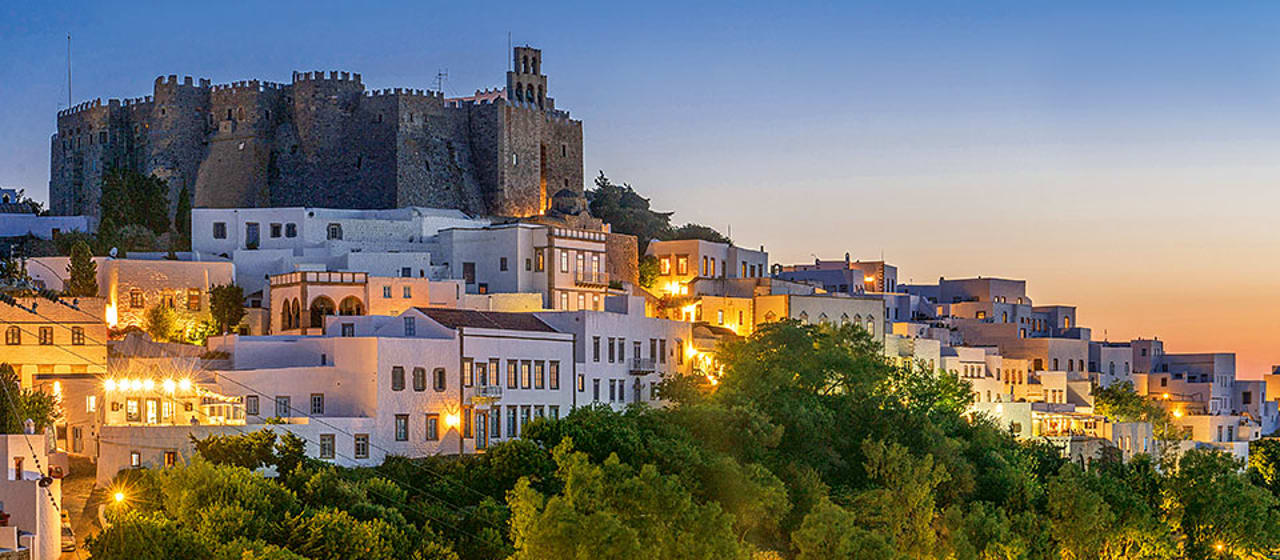
Patmos is the Jerusalem of the Aegean — John wrote Revelation in a cave here around 95 AD. He had been exiled by the Roman emperor Domitian, and the cave where he received the visions, together with the Monastery of St John — an 11th-century fortress on the summit — and the medieval Chora around it, form a UNESCO World Heritage Site. The Chora is one of the best-preserved medieval settlements in the Aegean, and for all its spiritual weight the island is not solemn: Skala's harbour is busy at night, the food is exceptional — pougkia, the savoury Patmian cheese pies, and thyme honey off the dry hillsides — and Psili Ammos, a half-hour walk or a boat ride from Skala, is the one beach worth the trouble. The rest are ordinary, and getting here filters the crowd: no airport, 7–9 hours from Piraeus. Skip August, when cruise ships dock daily, the Monastery becomes a conveyor belt and prices sit at maximum. June is the honest best month — the Cave and the Monastery walkable before the midday heat — and September, when the Chora returns to itself.
Good for
- Pilgrims and anyone drawn to sacred places — the Cave of the Apocalypse and the Monastery of St John are jointly UNESCO-listed
- Travellers who want one of the finest Choras in the Aegean, preserved like nowhere else in the Dodecanese
- Quiet holidaymakers who eat well — Patmos is the antithesis of the Dodecanese party island, with Psili Ammos a 30-minute walk away
Maybe skip if
- If you're coming in August — cruise ships dock daily, the Monastery becomes a conveyor belt and prices sit at maximum
- If you want a cheap, quick trip with headline beaches — no airport, 7–9 hours from Piraeus, ordinary beaches
Getting there
No airport. Ferries dock at Skala (the main settlement) on the Blue Star Dodecanese line.
Daily in summer, 4× weekly in winter. Patmos is roughly halfway down the line.
Tip: Closest air gateway is Samos — fly there, then 2h ferry south.
Best time to visit Patmos
Patmos is unusually civilized for the Dodecanese — the Monastery of St John, the Cave of the Apocalypse, a Chora preserved like nowhere else. Religious crowds at Easter and on September 26 (St John's day). General best: late May, early June, second half of September. Easter on Patmos is widely considered the most powerful in Greece — the Niptiras ceremony on Holy Thursday is unique.
Top beaches of Patmos
Psili Ammos Beach
The finest beach on Patmos — fine golden sand in a sheltered cove, accessible only on foot or by boat. Crystal clear water, pine trees and a simple taverna. The walking access keeps it quiet even in August.
- Type
- Fine golden sand
- Length
- 300 m
- Depth
- Shallow — crystal clear water
- Wind
- Avoid visiting when the wind blows from the southeast to southwest at over 5 Bft. South-facing — sheltered from the meltemi (the summer N/NE wind); calm in summer, exposed only to rare southern winds
- Facilities
- Basic: one small taverna. 30-minute walk or boat access from Skala.
Lambi Beach
Unique pebble beach on the north coast — the stones are an extraordinary range of colours: red, green, yellow, black and white. The geology alone makes it worth a visit. Good snorkelling.
- Type
- Multicoloured pebbles
- Length
- 400 m
- Depth
- Medium — clear water, good snorkelling
- Wind
- Avoid visiting when the wind blows from the northwest to northeast at over 4 Bft. North-facing — fully exposed to the meltemi (the dominant summer N/NE wind); often choppy June–September
- Facilities
- Good: small taverna, basic sunbeds.
Kampos Beach
The most accessible organised beach on Patmos — long sandy north-coast bay with calm water and good facilities. The beach village has the island's best tavernas outside Chora.
- Type
- Fine sand
- Length
- 500 m
- Depth
- Shallow — family-friendly
- Wind
- Avoid visiting when the wind blows from the northwest to northeast at over 5 Bft. North-facing — fully exposed to the meltemi (the dominant summer N/NE wind); often choppy June–September
- Facilities
- Good: sunbeds, tavernas, parking. The most developed beach on the island.
2-day itinerary for Patmos
Read the day-by-day plan on its own page →
Day 1: Chora & the Monastery
- 09:00 · Skala (Port)
The main port at sea level — a relaxed harbour town. Cafés and shops line the waterfront. Pick up a rental car or scooter here; the Chora and beaches require wheels.
- 10:00 · Cave of the Apocalypse
The small cave where John received the visions of Revelation around 95 AD. UNESCO World Heritage Site. The crack in the rock where God's voice emerged, and the stone where John rested his head, are preserved. Deeply atmospheric even for non-believers.
- 11:30 · Chora of Patmos
The hilltop capital of the island — one of the most beautiful preserved medieval settlements in the Aegean. White lanes, centuries-old mansions, and the great monastery dominating the summit.
- 13:00 · Monastery of St John
UNESCO-listed Byzantine monastery founded 1088. The treasury holds one of the most important collections of Byzantine manuscripts in the world. The view from the ramparts is extraordinary.
- 🍴 Stop for lunch · Chora — see Eat & Drink below
- 16:00 · Psili Ammos Beach
Patmos's most beautiful beach — a small crescent of fine white sand on the island's south coast, reached by short boat from Skala or a 30-minute walk. The contemplative quiet matches the island's monastic character. A swim and a tamarisk-shaded afternoon here is the natural counterweight to the spiritual weight of the morning's monastery and cave visits. - 20:00 · Skala Harbour Evening
Dinner at one of the harbour tavernas. The fish market at the quay sells what was landed that day.
Day 2: Beaches & Departure
- 09:30 · Psili Ammos Beach
The best beach on Patmos — a sandy cove accessible only by a 30-minute walk or by boat from Skala. Crystal clear water, pine trees, and a good small taverna at the waterline. - 12:30 · Lambi Beach
Famous for its multicoloured pebbles — the beach is strewn with red, green, yellow and white stones. Good snorkelling in the clear water. Small taverna. - 14:30 · Kampos Beach
Long sandy beach on the north coast — the most organised beach on the island, with sunbeds and tavernas. Calm, shallow water, good for families. - 17:30 · Skala — Departure
Ferry to Piraeus, Kos, Samos or the smaller Dodecanese islands. Patmos is a key stop on the northern Dodecanese ferry route.