
Agios Efstratios
3.3/5Ai Stratis — 270 residents, no cars, black sand beaches at the end of the Aegean
The village, the museum, a swim at Agios Antonios beach, dinner with the fishermen.
Agios Efstratios is the most isolated inhabited island in the Aegean — 270 people, no cars, no paved roads, protected by the Natura 2000 network. A volcanic island of black sand beaches, one of the largest oak forests in the Aegean, and sea caves where Mediterranean monk seals breed. Famous in Greek history as a place of exile — the composer Mikis Theodorakis and poet Giannis Ritsos were both interned here in the 1970s. The Museum of Democracy in the old school building tells that story. The island is aiming to become the first zero-emission Greek island. If you've been to the Cyclades five times and want something entirely different, this is it.
Good for
- Travellers who want the most isolated inhabited island in the Aegean — 270 people, no cars
- Anyone after black-sand beaches, an oak forest and a near-total absence of tourism
- Visitors interested in the island's exile history and its zero-emission ambitions
Maybe skip if
- If you want any choice of hotels, restaurants or activities — there is very little here
- If access is a concern; the only link is a ferry via Lemnos
Getting there
No airport. Tiny island south of Lemnos — daily summer ferry from Lemnos, ~2h. Population under 300.
Read full route
Tip: Ferry only runs once daily in most weeks — schedule planning matters.
Best time to visit Agios Efstratios
Agios Efstratios (Ai Stratis) is one of Greece's most isolated islands — a former exile-island for political prisoners. One settlement, one beach, one ferry a week. Open June-September. June or September are the windows. This is for travellers who want to be unreachable.
1-day itinerary for Agios Efstratios
Day 1: The Village & the Black Sand Beaches
- 09:00 · Harbour & Village
Your base. The single small harbour on the northwest coast and the village built directly behind it — 1968 prefabricated houses replacing those destroyed in a catastrophic earthquake. No taxis, no buses, almost no cars. You walk from here to everywhere on the island.
- 10:00 · Museum of Democracy
The restored 1909 Maraslios school — one of the few pre-earthquake buildings still standing. Tells the extraordinary story of the island's role as a place of political exile during the 20th century, when figures like Mikis Theodorakis, Yiannis Ritsos and Manos Katrakis were sent here. Small but moving.
- 11:00 · Church of Christ
The main village church, in the heart of what's left of old Agios Efstratios. Quiet, simple, with the everyday warmth of an island parish.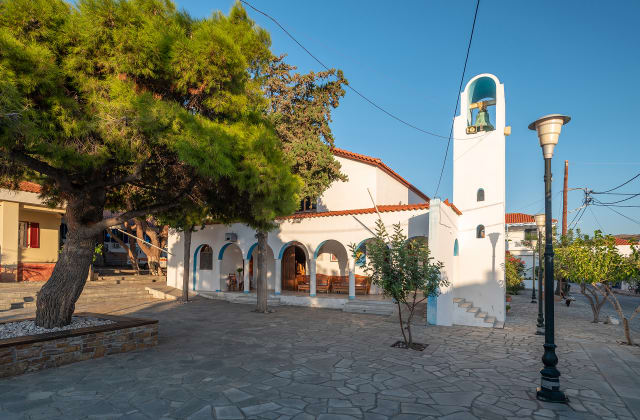
- 12:00 · Village Beach (volcanic black sand)
Walk straight from the village onto the dark volcanic sand. Calm shallow water, clean, almost no one. The most accessible swim on the island and many locals' favourite.
- 🍴 Stop for lunch · Harbour — see Eat & Drink below
- 16:00 · Agios Antonios Beach
About a 25-minute walk south from the village along the coastal dirt track. Quieter than the village beach, with the small chapel of Agios Antonios giving the spot its name. Crystal-clear water and almost guaranteed solitude.
- 🍴 Stop for dinner · Village — see Eat & Drink below
Top beaches of Agios Efstratios
Village Beach (Παραλία του Χωριού)
Right on the village waterfront — no walk at all, you step straight from the last houses onto black volcanic sand. Calm, shallow, clean water and almost never crowded. The most accessible swim on Agios Efstratios and many locals' favourite.
- Type
- Volcanic black sand
- Length
- 300 m
- Depth
- Shallow — calm, gentle sandy entry
- Wind protection
- West-facing — sheltered from the meltemi (the summer N/NE wind); calm most summer days, sometimes choppy on rare westerly winds
- Facilities
- None on the sand, but you're on the village waterfront — tavernas and rooms are a one-minute walk.
Agios Antonios Beach
A 25-minute walk south of the village along the coastal dirt track — easily walkable, no vehicle needed. Named after the little chapel of Agios Antonios beside it. Crystal-clear water and almost guaranteed solitude.
- Type
- Sand and fine pebble
- Length
- 150 m
- Depth
- Medium — crystal clear, deepens gently
- Wind protection
- Southwest-facing — sheltered from the meltemi (the summer N/NE wind); calm in summer, exposed only to rare S/SW winds
- Facilities
- None — bring water and shade. The small chapel of Agios Antonios beside it is the only structure.
Alonitsi Beach
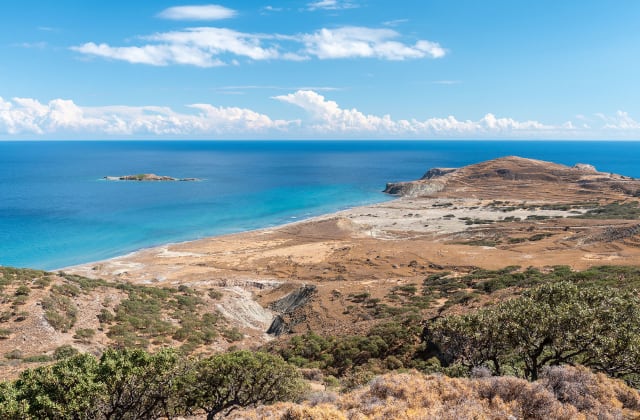
The island's longest beach (~1.5 km) on the far east coast, Natura 2000 protected — sand on the right, pebbles on the left. About an hour on foot from the village or a short 4x4 ride on the dirt road; walkable but long and shadeless, so most people drive. The largest and most isolated beach on the island.
- Type
- Sand right, pebbles left
- Length
- 1.5 km
- Depth
- Medium
- Wind protection
- East-facing — mostly sheltered from the meltemi (the summer N/NE wind); can be choppy on the strongest NE days
- Facilities
- None — Natura 2000 protected and fully wild. Bring everything: water, food, shade.